Executive Summary
• Water, or H₂O, makes up 98–99% of your filtered coffee, making it the most critical factor, yet it’s often overlooked. It’s important to focus on water quality before investing in beans, grinders, or machines.
• Water that is safe to drink is not necessarily good to brew coffee. India’s tap and treated water typically carry 3×–5× the minerals and alkalinity coffee requires, dulling its acidity and clarity.
• Water constituents to be kept in mind. Target 75–150 mg/L TDS with magnesium-led hardness and low alkalinity — achieved through reverse osmosis and remineralisation, and confirmed by GH/KH testing.
“Water is the driving force of all nature.”
— attributed to Leonardo da Vinci
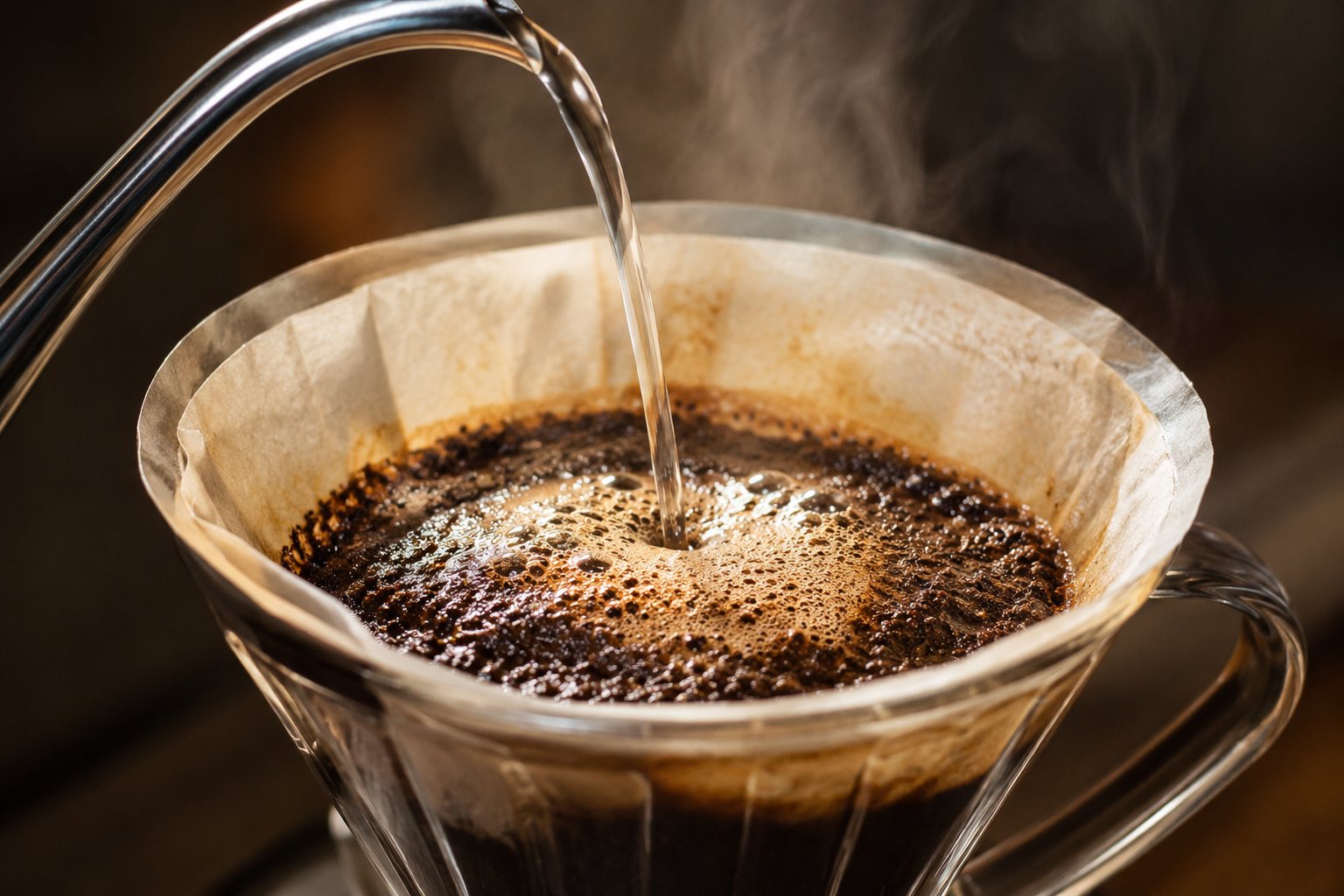
Nothing rings truer than when one sets out to understand coffee — the elixir of my life. A startling fact frames the subject: a brewed filter cup is about 98–99% water, and even an espresso is roughly 90% — yet water is the most overlooked part of coffee preparation.
When I brew with my contraption of set-pieces, Loren Eiseley’s line hums in my head — “If there is magic on this planet, it is contained in water” — and I pause to notice the quiet alchemy in the cup. To put things in to context, Water Chemistry is what gives coffee its flavour and body – tapping into one’s olfactory senses, besides some visual aspects.
In the Cup: Why Water Decides Flavour
Water does the extracting. Its hardness, alkalinity and ion balance draw the flavour notes from roasted coffee, and the Specialty Coffee Association (SCA) frames the goal as the “Golden Cup” — an extraction yield of 18–22%. The parameters that matter are Total Dissolved Solids (TDS), total hardness and total alkalinity — measured as General Hardness (GH) and Carbonate Hardness (KH) — together with the key ions: Magnesium (Mg²⁺), which extracts flavour most effectively; Calcium (Ca²⁺), which adds body; and Bicarbonate (HCO₃⁻), the buffer that, in excess, mutes a cup’s brightness.
One caution: “TDS” has two senses. Water TDS is the mineral content going in; Beverage TDS is the strength of the finished cup (about 1.15–1.35% for filter, 8–12% for espresso). This piece concerns the water going in.
The Problem: Safe to Drink, Wrong to Brew
Water that is legal and safe to drink is not necessarily good to brew. India’s tap and treated water typically carry several times the minerals and alkalinity coffee wants — a peer-reviewed survey of Bengaluru drinking water elucidates this.
Exhibit 1 · Bengaluru Tap Water vs. Coffee’s Target How Far India’s Water Exceeds Coffee’s Ideal A peer-reviewed Bengaluru reading, shown as multiples of coffee’s ideal level (= 1×). |
|
Source: Khayum et al. (2011), Nature Environment and Pollution Technology, 10(2). |

The biggest issue is Alkalinity, which cancels out the acidity coffee needs. Chlorine is simpler: it is required in Indian drinking water for safety and must be filtered out before brewing. The full specification — specialty-coffee targets alongside India’s drinking-water standard — is set out in Exhibit 2.
Exhibit 2 · Brewing Water — Specification Comparison What Coffee Wants vs. What India Pours Specialty-coffee targets beside India’s drinking-water standard. All concentrations in mg/L; pH is unitless. | |||
Parameter | SCA-102:2024 — cupping | SCAA 2009 — brewing (heritage) | BIS IS 10500:2012 — drinking (acceptable / permissible) |
Total Dissolved Solids (TDS) | N/A ¹ | 150 (75–250) | 500 / 2000 |
Total hardness (as CaCO₃) | 50–175 ² | ~68 (17–85) | 200 / 600 |
Calcium (Ca²⁺) | N/A | N/A | 75 / 200 |
Magnesium (Mg²⁺) | N/A | N/A | 30 / 100 |
Total alkalinity (as CaCO₃) | 40–70 | ~40 | 200 / 600 |
pH | 6–8 | 6.5–7.5 | 6.5–8.5 |
Sodium (Na⁺) | N/A | ~10 | N/A ³ |
Chloride (Cl⁻) | N/A | N/A | 250 / 1000 |
Sulphate (SO₄²⁻) | N/A | N/A | 200 / 400 |
Free residual chlorine | none | 0 | 0.2 (min) / 1.0 ⁴ |
¹ SCA-102:2024 sets no water-TDS target; on the SCA’s website “TDS” denotes brewed beverage strength, not water — the 150 mg/L figure survives only in the 2009 chart. | |||
² SCA-102 lists “calcium hardness”, the 2009 chart “total hardness”; both are expressed as CaCO₃. ³ BIS sets no direct sodium limit. ⁴ BIS requires a minimum 0.2 mg/L free residual chlorine when chlorinated — the reverse of coffee’s zero. | |||
Source: SCA Standard 102-2024, Table 2; SCAA (2009), Water for Brewing Specialty Coffee; Bureau of Indian Standards, IS 10500:2012. | |||
This is why Reverse Osmosis (RO) is near-universal in Indian cafés. But RO is only half the answer: by removing 90–99% of dissolved solids, it leaves the water with almost nothing to extract with, and the cup turns thin and sour. The fix is to add minerals back, led by magnesium, to enhance the flavour profile.
Upstream, in Brief
Water quality matters before the cup, too. Coffee is salt-sensitive, so irrigation water should stay low in salinity and bicarbonate; and in washed processing, the water interacting with the bean must be clean — odourless, colourless, flavourless. Recycling pulping water from washed coffee is generally discouraged because it can reduce quality by causing over-fermentation and taint. Although micro / nano-filtration can help address these issues, it tends to be expensive.
Currently, no coffee-specific numeric standard governs irrigation or washing of coffee. However, the most acceptable irrigation standards are those of FAO and BIS, tabulated in the Appendix (Exhibit 4).
Getting It Right
For brewing, aim for roughly 75–150 mg/L TDS, hardness led by magnesium, and alkalinity near 40 mg/L, and verify with an inexpensive GH/KH test; per-method targets and ion ranges are in the Appendix (Exhibits 5–6). The same logic scales from a single cup at home to a busy bar (Exhibit 3).
Exhibit 3 · Putting It Into Practice Applying the Guidance: Home vs. Professional Café Setup The same principles, scaled to your setup. | ||
At home | In a Professional Setup | |
Test with | TDS meter plus a GH/KH drop kit | Inline TDS monitor; periodic GH/KH test or a lab water report |
Fix with | Bottled/RO water plus sachets (e.g. Third Wave Water) or a DIY Epsom-salt + baking-soda recipe | RO with a magnesium-dosing remineralisation cartridge; a set descaling schedule |
Watch for | Chlorine (add a carbon filter); water left too soft by RO | Boiler scale, cup-to-cup consistency, and the repair/downtime cost of neglect |
Source: Barista Hustle, Home Espresso Lab and Scott Rao (see References). | ||
Key Takeaways
• Diagnose the water first. It’s often not the beans but the water: Indian tap and filtered water are typically hard and markedly more alkaline (around 4–5×), and the elevated bicarbonate reduces perceived acidity and clarity in the cup.
• Judge composition, not TDS alone. TDS is a useful first check, not a complete one — the same TDS can taste different. Flavour depends on hardness (Ca²⁺, Mg²⁺) and alkalinity (HCO₃⁻); aim for a TDS of 75–150 mg/L, with hardness led by magnesium and alkalinity around 40 mg/L. A GH/KH test reveals this balance.
• Remineralise after Reverse Osmosis (RO). RO fixes India's hard water by removing minerals; however, it can make coffee taste weak, sour, and hollow. Therefore, wherever possible, remineralise with magnesium to draw out more flavour.
• Manage water quality upstream too. Coffee is salt-sensitive, so irrigation water should stay low in salinity and bicarbonate; in washed processing, the water must be clean, since contamination and over-recycling leave taints no refined brewing can undo.
Get the water right, and everything downstream — bean, grind and method — savour coffee’s flavour.
Appendix — Reference Data
Exhibit 4 · Upstream — Irrigation & Planting Water Irrigation Water Quality: FAO and BIS Standards No coffee-specific numeric standard exists; irrigation borrows agronomy’s rulebooks. FAO rates by restriction on use, BIS by suitability class. Units vary by parameter, as noted in each row. | ||
Parameter (unit) | FAO — Ayers & Westcot (none / slight–moderate / severe) | BIS IS 11624:2019 (Low / Medium / High / Very-high) |
Total Dissolved Solids, TDS (mg/L) | <450 / 450–2000 / >2000 | N/A (rated via EC) |
Salinity, EC (dS/m) | <0.7 / 0.7–3.0 / >3.0 | <1.5 / 1.5–3.0 / 3.0–6.0 / >6.0 |
Sodium Adsorption Ratio, SAR (unitless) | rated jointly with EC | <10 / 10–18 / 18–26 / >26 |
Residual Sodium Carbonate, RSC (meq/L) | N/A | <1.5 / 1.5–3.0 / 3.0–6.0 / >6.0 |
Boron (mg/L) | <0.7 / 0.7–3.0 / >3.0 | <1.0 / 1.0–2.0 / 2.0–4.0 / >4.0 |
Chloride, Cl⁻ — surface irrigation (mmol/L) | <4 / 4–10 / >10 | N/A |
Bicarbonate, HCO₃⁻ — sprinkler (mmol/L) | <1.5 / 1.5–8.5 / >8.5 | N/A |
pH (unitless) | 6.5–8.4 (normal range) | N/A |
Coffee is salt-sensitive — keep irrigation water in FAO’s “none” band (EC < 0.7 dS/m); high bicarbonate also clogs drip emitters. China GB 5084-2021 is the East-Asian national standard but a pollutant / reuse-limits standard (a different remit). | ||
Source: FAO Irrigation & Drainage Paper 29, Rev.1 — Ayers & Westcot (1985); Bureau of Indian Standards, IS 11624:2019. | ||
Exhibit 5 · Cupping & Cup — Mineral Targets Recommended Ion Ranges for Brewing Water Targets for building or correcting water. Hardness and alkalinity are officially specified as CaCO₃ equivalents; these are the corresponding per-ion figures. | ||
Ion | Recommended range (mg/L) | Role in the cup |
Magnesium (Mg²⁺) | 10–30 | Primary flavour-extracting cation; low scale risk |
Calcium (Ca²⁺) | 0–30 | Adds body and hardness; the main scale culprit |
Bicarbonate (HCO₃⁻) | 40–50 | The buffer — keep it low; high levels mute brightness |
Sodium (Na⁺) | <10 | No flavour benefit; avoid softened water |
Conversions: hardness (as CaCO₃) × 0.40 = Ca²⁺; × 0.24 = Mg²⁺; alkalinity (as CaCO₃) × 1.22 = HCO₃⁻. | ||
Source: Derived from SCA CaCO₃-equivalent targets and practitioner consensus (Barista Hustle; Rao); ion mechanism per Hendon et al. (2014). | ||
Exhibit 6 · Fine-Tuning — By Brewing Method Brewing-Water Targets by Method The SCA/cupping bands are deliberately wide; effective brewing uses tighter, method-specific targets. | |||||||
Method | TDS (mg/L) | GH (as CaCO₃) | KH (as CaCO₃) | Na⁺ | Chlorine | Note | |
Espresso | 75–150 (aim ~80–100) | 50–80 | ~40 (35–50) | <10 | 0 | Keep minerals low – boiler scales | |
Filter / Pour-over | 100–175 | 50–100 | ~40 (17–50) | <10 | 0 | Higher hardness aids extraction | |
Immersion / Cuppin | — | 50–175 | 40–70 | <10 | 0 | Per SCA-102:2024 | |
TDS, Na⁺ and chlorine in mg/L; GH and KH as CaCO₃. GH = general hardness (Ca²⁺ + Mg²⁺), KH = carbonate hardness (alkalinity). Named tight recipes: Rao GH 76 / KH 50 · Hendon-zone centre GH 100 / KH 31 · Barista Hustle GH 81 / KH 40. | |||||||
Source: Home Espresso Lab; Barista Hustle; Scott Rao; SCA Standard 102-2024 (immersion / cupping). | |||||||
Abbreviations
BIS — Bureau of Indian Standards
CaCO₃ — Calcium carbonate — the basis for expressing hardness and alkalinity
Ca²⁺ / Mg²⁺ / Na⁺ — Calcium, magnesium and sodium ions
Cl⁻ / HCO₃⁻ / SO₄²⁻ — Chloride, bicarbonate and sulphate ions
EC — Electrical conductivity — a measure of salinity (dS/m)
FAO — Food and Agriculture Organization of the United Nations
GH / KH — General hardness (Ca²⁺ + Mg²⁺) / carbonate hardness (alkalinity, buffer)
RO — Reverse osmosis
RSC — Residual sodium carbonate (meq/L)
SAR — Sodium adsorption ratio
SCA / SCAA — Specialty Coffee Association (SCAA — its predecessor body)
TDS — Total dissolved solids (mg/L)
WHO — World Health Organization
References
Hendon, C. H., Colonna-Dashwood, L., & Colonna-Dashwood, M. (2014). The Role of Dissolved Cations in Coffee Extraction. Journal of Agricultural and Food Chemistry, 62(21), 4947–4950. https://doi.org/10.1021/jf501687c
Zhang, S. J., et al. (2019). Influence of Various Processing Parameters on the Microbial Community Dynamics, Metabolomic Profiles, and Cup Quality During Wet Coffee Processing. Frontiers in Microbiology, 10, 2621. https://doi.org/10.3389/fmicb.2019.02621
Khayum, A., Nandini, N., Durgesh, R., & Reddy, P. S. (2011). Assessment of Drinking Water Quality in South Central Zone of Bangalore City. Nature Environment and Pollution Technology, 10(2), 285–287. https://neptjournal.com
Specialty Coffee Association (2024). SCA Standard 102-2024 — Sample Preparation and Tasting Mechanics (Table 2). https://sca.coffee/research/coffee-standards
Specialty Coffee Association of America (2009). Water for Brewing Specialty Coffee (heritage water-quality standard).
Bureau of Indian Standards (2012). IS 10500:2012 — Drinking Water — Specification (Second Revision). https://www.bis.gov.in/other/DrinWatIS10500.pdf
Bureau of Indian Standards (2019). IS 11624:2019 — Quality of Irrigation Water — Guidelines. https://archive.org/details/gov.in.is.11624.2019
Ayers, R. S., & Westcot, D. W. (1985). Water Quality for Agriculture. FAO Irrigation and Drainage Paper 29, Rev.1. FAO, Rome. https://www.fao.org/4/t0234e/t0234e00.htm
World Health Organization. Guidelines for Drinking-water Quality. https://www.who.int/teams/environment-climate-change-and-health/water-sanitation-and-health/water-safety-and-quality/drinking-water-quality-guidelines
Cenicafé (Colombia), via Perfect Daily Grind (2019) — processing-water quality. https://perfectdailygrind.com/2019/02/how-to-improve-quality-when-processing-washed-coffees/
Barista Hustle — remineralisation & water recipes · Home Espresso Lab — per-method targets · Scott Rao — brewing-water guidance. https://www.baristahustle.com/what-can-we-use-to-remineralise-water/
Eiseley, L. (1957). The Immense Journey. Random House. · “Water is the driving force of all nature” — popularly attributed to Leonardo da Vinci (attribution unverified).